A lead measured in millions
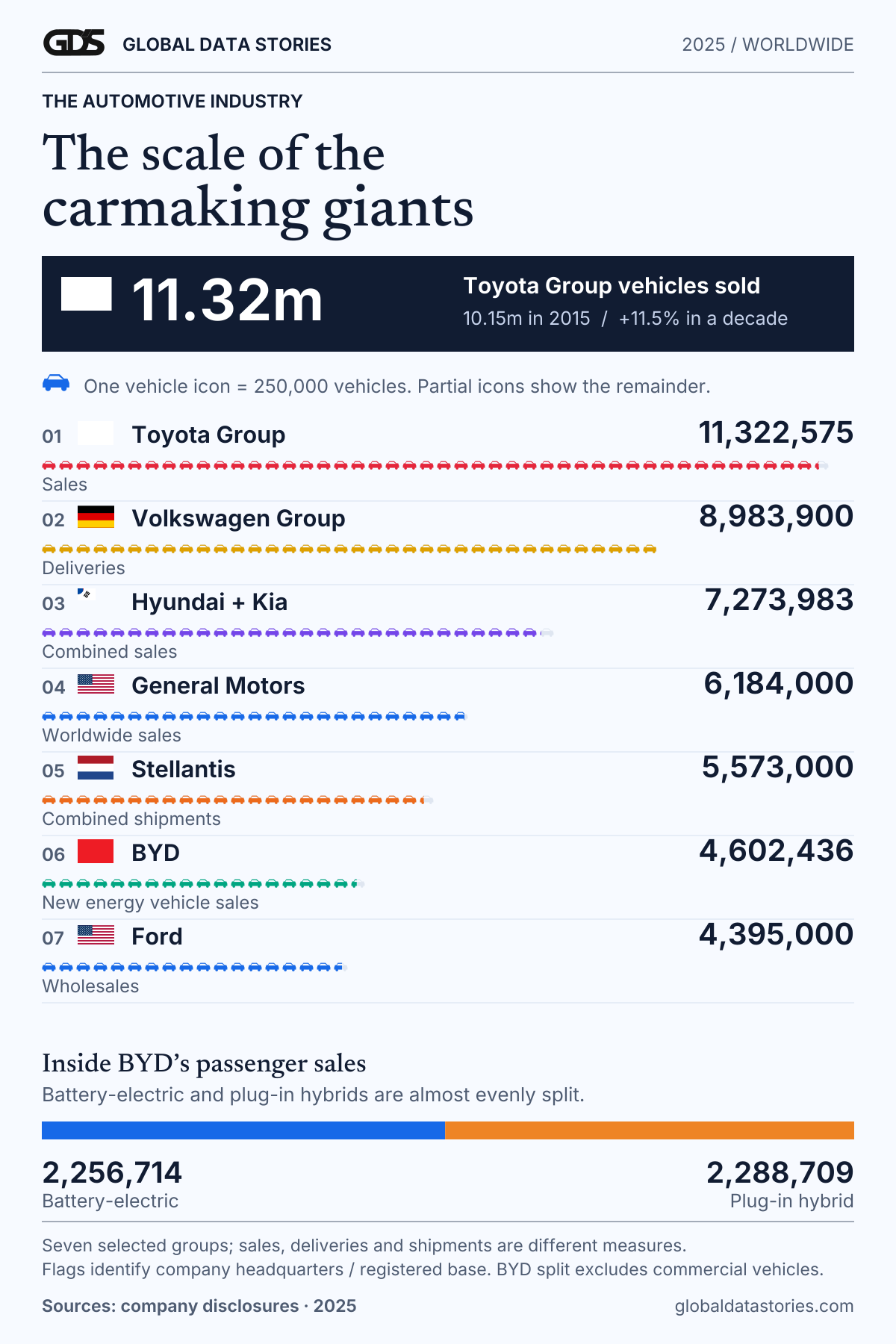
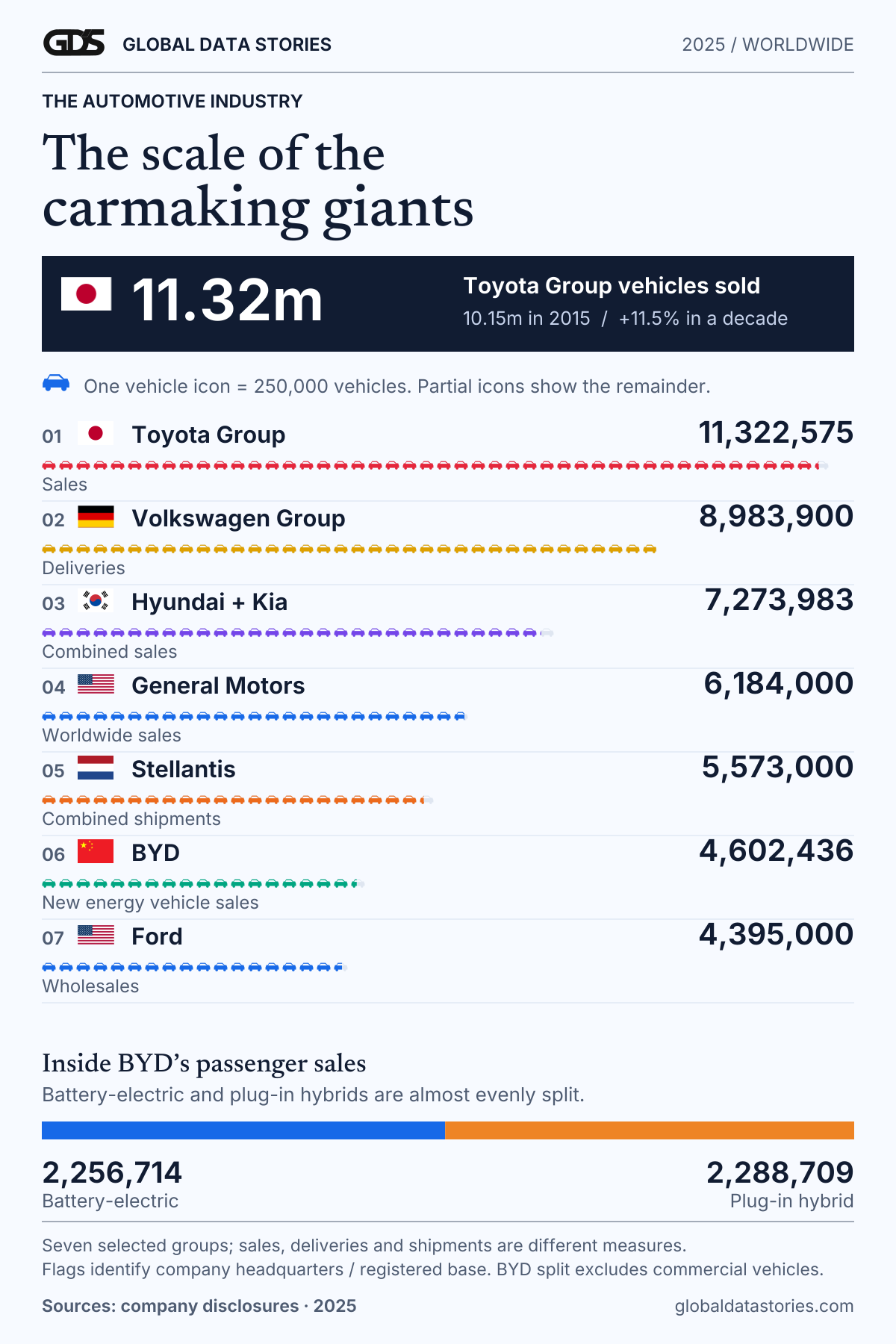
Toyota Group sold 11,322,575 vehicles in 2025, including Toyota and Lexus, Daihatsu and Hino. Volkswagen Group delivered 8,983,900. The difference between those reported totals is 2,338,675 vehicles: Toyota’s volume was about 26% larger. These are whole groups, covering more than the passenger cars carrying their best-known badges. [1] [2]
The next numbers are substantial in their own right. Hyundai reported 4,138,180 sales and Kia 3,135,803, giving a combined 7,273,983. General Motors reported worldwide sales of approximately 6.184 million. Our graphic shows seven major groups using their own published measures, with the definition printed beside each figure. It is a comparison of industrial scale, not a claim that every bar is an identical retail-sales measure. [3] [4] [5]
BYD is no longer a small challenger
BYD’s December filing put full-year new energy vehicle sales at 4,602,436, up 7.73% from 2024. Of that total, 4,545,423 were passenger vehicles and 57,013 were commercial vehicles. Calling all 4.6 million “fully electric cars” would be wrong. Its passenger total comprised 2,256,714 battery-electric vehicles and 2,288,709 plug-in hybrids. The two technologies were almost equally represented. [6]
That distinction matters when comparing strategies. A battery-electric vehicle relies on a rechargeable battery for propulsion. A plug-in hybrid also has a combustion engine. Both are included in BYD’s new energy vehicle total, but they place different demands on charging infrastructure and fuel supply.
The International Energy Agency reports that more than 13 million electric cars were sold in China in 2025. In its terminology, electric cars include battery-electric and plug-in hybrid models. Such a large home market gives manufacturers room to spread development costs across many customers, although a large market alone does not prove that every producer is profitable. [9]
Why Ford can move in a ranking without selling another vehicle
Ford reported 4.395 million wholesale vehicles for 2025. Wholesales are primarily vehicles sold to dealers, with the company’s disclosed scope including certain affiliate and other-brand production. Retail sales measure a later stage: a vehicle reaching an end customer. Dealer inventories can make these totals diverge within the same year. [7]
For that reason, BYD’s 4.602 million sales and Ford’s 4.395 million wholesales do not establish a clean retail-sales victory. A ranking assembled from different sources can appear more precise than the underlying comparison. We show both numbers, name both measures and avoid turning the difference into a claim they cannot support.
Stellantis presents another useful distinction. It reported 5.484 million consolidated shipments, but 5.573 million combined shipments when joint ventures are included. We use the combined figure and label it accordingly. Switching between those two measures changes the bar by 89,000 vehicles without changing the underlying business. [8]
A decade changes the companies as well as the numbers
Toyota’s own calendar-2015 release recorded 10,150,726 worldwide customer deliveries for Toyota/Lexus, Daihatsu and Hino. Its 2025 total is roughly 11.5% higher. That is a useful long-term comparison because the named group scope is visible at both endpoints. It does not imply uninterrupted growth between them. [1] [10]
A historical ranking also has to account for mergers, disposals and joint ventures. Stellantis was formed from PSA and Fiat Chrysler in 2021, so drawing one continuous line back to 2015 requires a stated reconstruction of its predecessors. Adding companies together after a merger is different from organic sales growth. [8]
The practical reading is straightforward: Toyota and Volkswagen still operate at enormous scale, Hyundai and Kia form another large manufacturing base, and BYD is now a major volume producer. To judge commercial strength beyond that scale, the next questions are margins, customer demand, product mix and the cash required to keep developing vehicles. A vehicle-count chart answers the size question; it cannot answer all of those at once.