
An annual reading, with uncertainty
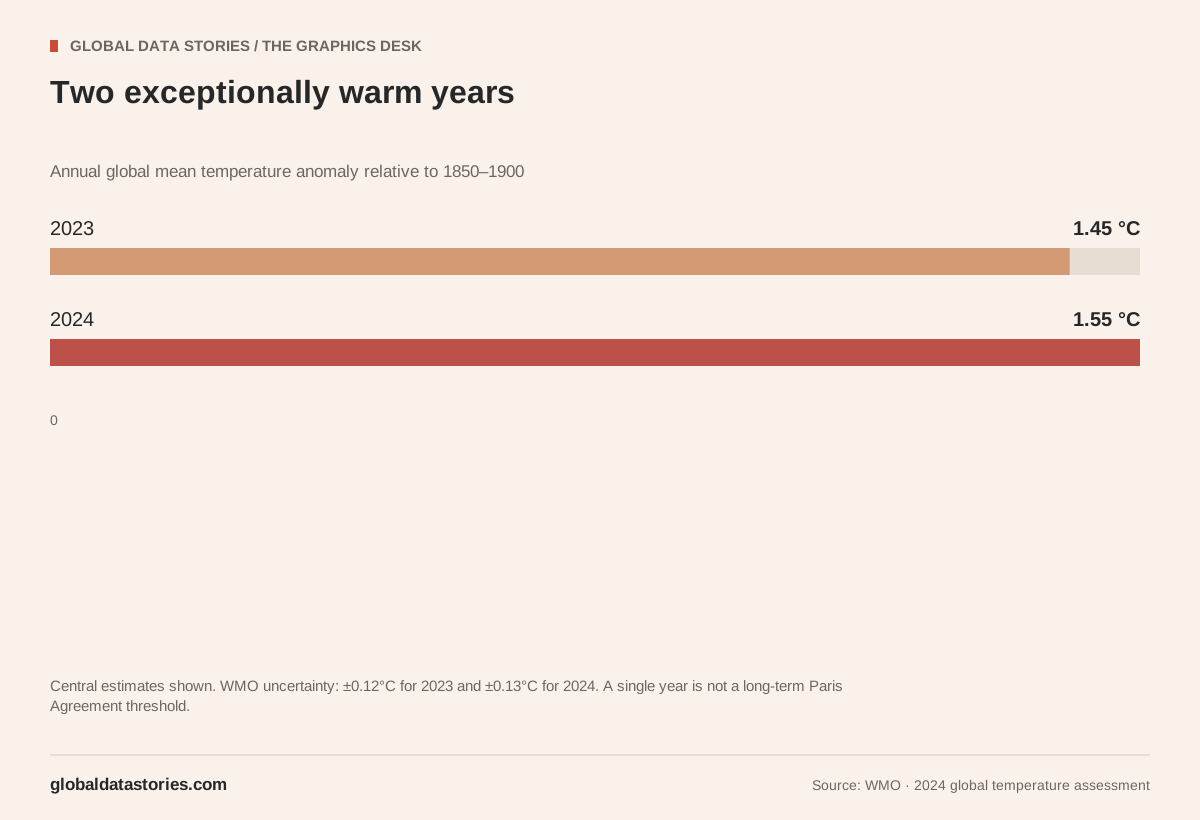
The World Meteorological Organization assessed 2024's global mean surface temperature at 1.55°C above the 1850–1900 average, with uncertainty of ±0.13°C. Its assessment for 2023 was 1.45°C, with uncertainty of ±0.12°C.
The bars show those central estimates. They do not imply that the measurements are exact to a hundredth of a degree, or that a two-year comparison captures the full climate trend.
Why another dataset says 1.60°C
Copernicus reported a 2024 anomaly of 1.60°C using the ERA5 dataset. WMO's figure combines six international datasets. Differences in methods and reference estimates mean the published numbers are not identical.
Copernicus also reported 11 months of 2024 above 1.5°C in ERA5. Its report makes clear that the number of months can change with the dataset used. A fair comparison keeps the source and baseline visible, rather than switching between series without explanation.
One year is not several decades
WMO distinguishes a calendar year's temperature from the long-term warming addressed by the Paris Agreement. An individual year above 1.5°C does not, by itself, establish that the long-term threshold has been crossed.
The distinction does not make the annual reading unimportant. It makes the timescale explicit. This chart describes 2023 and 2024; it is neither a statement about every location's temperature nor a measurement of warming averaged over decades.